







Photograph a car body correctly
Many cars have almost identical bodies and can sometimes be difficult to distinguish even for a trained eye, so good pictures with all the details are important and very helpful to us. How to photograph your car's body for a complaint case.
1. Squat down so that the camera is level with the exterior rear-view mirrors when taking pictures
2. Keep a distance, usually at least 3 metres depending on the car, so that you get all the details such as headlights, grille, door sides, front and rear bumpers, etc. It is usually through the details that we can determine the exact body model.
1. Photograph from behind

Wrong: Do not photograph the car from behind like this

Correct: Photograph the car from behind as follows.
2. Photograph from the side
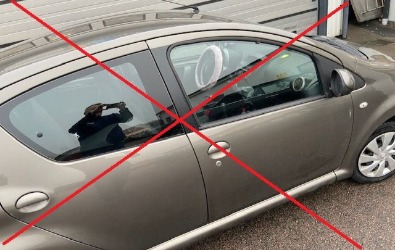
Wrong: Do not photograph the car from the side like this

Correct: Photograph the car from the side like this.
3. Photograph from the front

Wrong: Do not photograph the car from the front like this.

Correct: Photograph the car from the front like this.
Photograph a complaint correctly
How to photograph your car and the films so that we can help you in the best way with your complaint.
1. Photography from the outside

Wrong: Detail pictures of gaps cannot be used to handle a complaint case.

Correct: You need to see the entire window and the film to be able to assess the installation and any production defects.
2. Photography from the inside

Wrong: Detail pictures of gaps on one side of, e.g., a rear window cannot be used to handle a complaint case.

Correct: Regardless of whether there is a fault on one side or if there is a fault on both sides, an image is needed that shows the entire film so that you can see both sides of the glass to be able to handle the complaint.
3. Measure and state deviations

Wrong: Do not photograph images on scales as it becomes a question of interpretation which dimension the image shows.

Correct: Always state dimensions in writing and in millimetres. (NOTE: the measurement does not need to be shown in a photo; the example above is for illustration only.)
4. Always install the film before photographing

Wrong: The film must always be installed on the inside to be able to judge the fit and size. Pictures of film placed on the outside of the glass to assess fit cannot be accepted as a basis for complaint (unless the error is very obvious).

Wrong: Images of partly installed film cannot be used in a complaint case as it is not possible to assess either the size or fit of film that is not fully installed (unless the error is very obvious).
5. Photograph shipping damage

Wrong: In order to be able to make a complaint about shipping damage, you do not need a picture of the missing goods but of the damage.

Correct: Photograph the entire package so that you can clearly see the damage when you make a claim for shipping damage.
6. Cut up and photograph the film

Please note: the film must be cut into pieces so that it cannot be reused or resold before you invoke one of our guarantees.
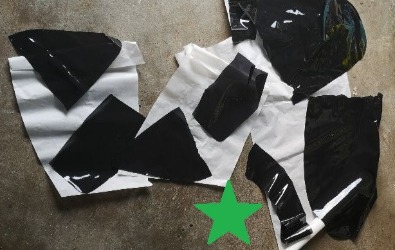
Correct: All pieces are shown in the picture and have been cut in the middle.